
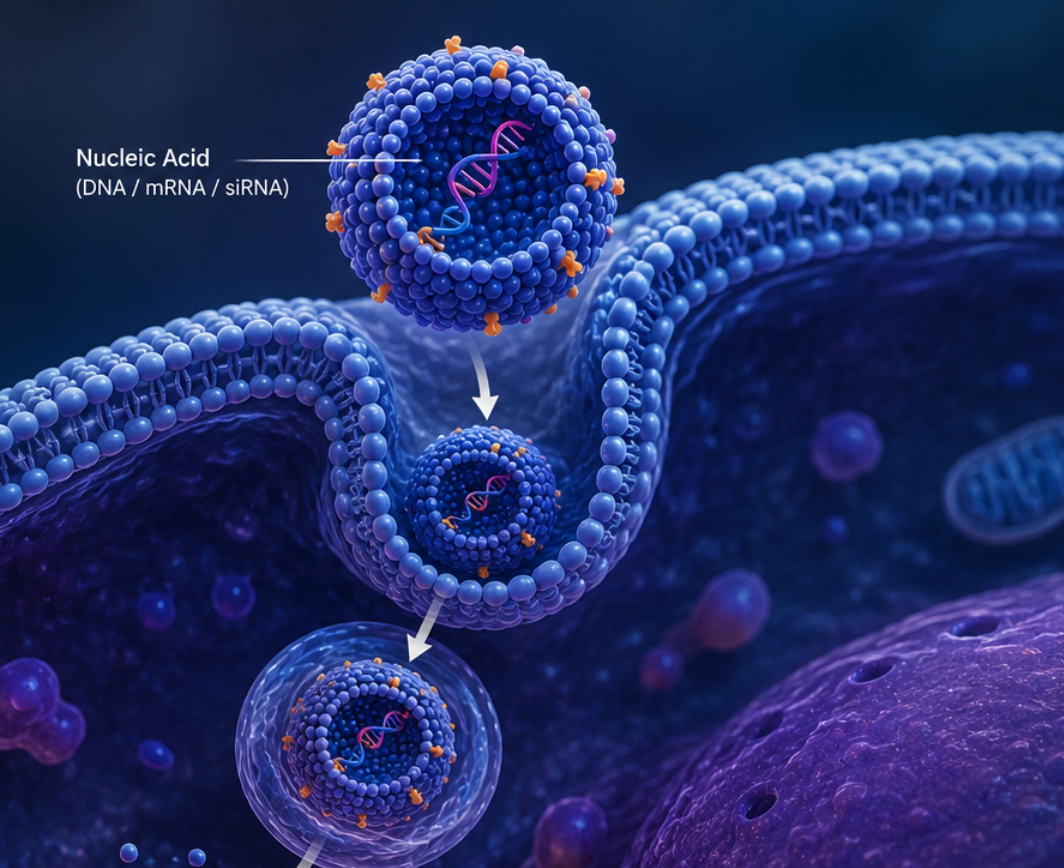
Existing gene-delivery approaches frequently rely on viral vectors or lipid-based delivery systems, which can present limitations related to payload capacity, immune response, manufacturing complexity, and repeat administration. Researchers at Cincinnati Children’s identified cellular proteins that interfere with efficient gene transfer and developed approaches to reduce those intracellular barriers.
A non-viral, non-lipid nucleic-acid delivery platform designed to improve intracellular uptake and gene transfer while addressing limitations associated with conventional viral vectors and lipid nanoparticles. Initial development is focused on cystic fibrosis. The platform combines compacted nucleic-acid delivery with molecular strategies that modulate cellular proteins interfering with gene transfer. RNAi molecules and small-molecule approaches are used to reduce or inhibit specific cellular barriers to nucleic-acid uptake, thereby enhancing intracellular delivery and downstream gene transfer.
An immunocapture-based analysis identified 523 proteins associated with interference in gene transfer. Two complementary strategies were identified: RNAi-mediated knockdown of specific cellular proteins and small-molecule modulation of proteins that impede nucleic-acid entry and transfer.
| Non-Viral, Non-Lipid Delivery | Avoids reliance on conventional viral vectors and lipid nanoparticles. |
| Large Genetic Payload Capability | Designed to enable transfer of large genetic payloads that can be constrained by some conventional delivery systems. |
| Enhanced Intracellular Uptake | Uses targeted RNAi and small-molecule approaches to reduce cellular barriers that interfere with nucleic-acid uptake and gene transfer. |
| Addresses Current Delivery Limitations | Intended to address limitations associated with immunogenicity, payload capacity, safety, and manufacturing complexity of existing gene-delivery approaches. |
| Platform Potential | Initially developed for cystic fibrosis, with potential applicability to additional nucleic-acid and genetic-medicine programs. |

Seeking partnership